George W Bush Is Popular Again
George Westward. Bush Carries Some Blame for the Current Conflict With Putin
Russia filed a report to the United Nations on Thursday, accusing Ukraine of committing acts of "genocide" against the "Russian-speaking population" in the country'southward war-torn Donbass region. President Vladimir Putin could well employ the charge—which seems to have no basis in fact—every bit a pretext to invade at to the lowest degree that area of Ukraine.
Too on Th, the Russian foreign ministry issued a lengthy statement threatening to accept "military-technical measures" if the United States did not accept all of Moscow's proposals on how to settle the crisis—even while knowing that, in Washington'southward eyes, some of those proposals are nonstarters.
Meanwhile, officials say in that location is withal no evidence that Russia has moved any of its 150,000 troops abroad from the Ukrainian edge, despite Putin's assurances to the reverse.
Together, these developments suggest that Putin might soon take some class of military action against Ukraine—well-nigh likely an occupation of Donbass, which is controlled by pro-Russia separatist militias. Such activeness would be accompanied past official recognition of the region'south two provinces, the then-chosen Donetsk and Luhansk People's Republic, as contained states, a movement that the Russian parliament this calendar week authorized him to take.
This would autumn far short of the all-out invasion of Ukraine that some Western observers have feared—but information technology would also preempt any chances of a diplomatic solution to the crisis.
The foreign ministry'southward statement does lay out some possible routes for continued diplomacy and fifty-fifty a peaceful settlement of the crisis, but even they contain some poison pills that, at this point, make the scenario of a express invasion seem more probable. For example, ane of the certificate's most specific passages lays out what it calls the "fundamentally important" steps to "de-escalate the situation":
These are forcing Kiev [Ukraine's capital, which Ukrainians spell Kyiv] to comply with a set of measures, stopping the supply of weapons to Ukraine, withdrawing all Western directorate and instructors from there, refusing NATO countries from whatever articulation exercises with the Military machine of Ukraine, and withdrawing all foreign weapons previously delivered to Kiev outside Ukrainian territory.
Let's parse that passage. Get-go, forcing Kyiv to comply with "a prepare of measures" is a bit vague, sounds like an invitation to negotiate—OK. Side by side, disallowment NATO from holding joint exercises with Ukraine'south regular army is easy—at that place are no such exercises now or for the foreseeable future, and so nosotros'll accept that one too. The other proposals—stopping the supply of weapons and withdrawing the weapons already shipped besides equally the advisers training Ukrainian soldiers in how to use them—are plausible, equally long equally Russia pulls back its troops from the border. However, Putin has said he has the sovereign correct to move troops anywhere he wants inside Russian territory—which, legally, is true. So unless Putin makes a compromise here, that's the end of that.
The document repeats Putin's denial that he has any intent to invade Ukraine, arguing that Russia's contempo troop movements accept been in response to threatening actions taken by the U.S. and NATO inside Ukraine, including the cosmos of an expansive "military infrastructure." Information technology expresses the fear that, if it joined NATO, Ukraine could forcibly endeavor to take back Crimea—which Russia annexed in 2014—and would then call on its NATO allies to help.
Again, permit'southward unpack this statement. It is true that Putin'southward acts of 2014—annexing Crimea and sending in troops to support separatist militias in the Donbass—were motivated by the ouster of Ukraine's pro-Russia president and the growing desire of Kyiv's new leaders to move out of Moscow's orbit and join the European Spousal relationship. Even so, every bit Putin has been told many times, the thought of Ukraine joining NATO, though much desired by President Volodymyr Zelensky, is not remotely on the alliance's agenda; the "military infrastructure" in Ukraine consists of a few hundred U.Southward war machine personnel; and the weapons the West has been sending to Ukraine consist mainly of fairly basic anti-tank and anti-aircraft missiles—nothing to support an offensive performance.
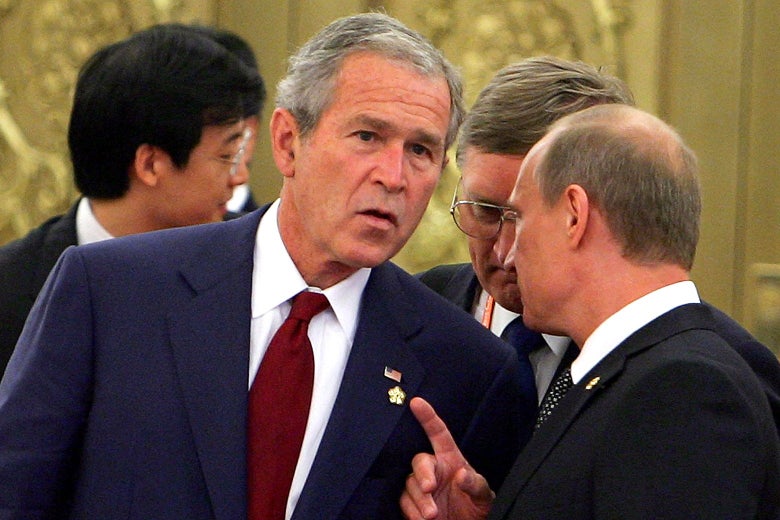
Russia'southward document is on somewhat more than solid ground in lashing out against NATO'due south "enlargement" policy of the 1990s, in which the U.S.-led military brotherhood—emboldened past its Cold War victory—absorbed almost every former member of the Soviet-led Warsaw Pact (who all practically begged to join). Ukraine was pointedly not among those nations, in function because even the policy'due south most ardent advocates recognized that bringing in Russian federation's largest Western neighbor—a country with which it had centuries-old historical, economical, and cultural ties—would be besides provocative. Then, in 2008, at a NATO summit in Bucharest, Romania, President George W. Bush crossed that Rubicon, committing NATO to bringing in Ukraine and Georgia—another former Soviet commonwealth left out of the previous decade'due south enlargement—at some signal in the undefined hereafter.
The Russian strange ministry building'southward document demands the repeal of Bush's resolution, the halt of further eastward enlargement, and the removal of U.S. armed services forces from many of the old Soviet allies that joined NATO a quarter-century ago.
As M.E. Sarotte chronicles in her fascinating new volume, Not Ane Inch, NATO managed to aggrandize so vastly in the decade following the end of the Common cold State of war just because Russia was too weak to put upwardly a fuss. The concluding Soviet president, Mikhail Gorbachev, let the first wave of expansion happen on assurances that it wouldn't go much further. The first Russian Federation president, Boris Yeltsin, allowed the adjacent, much larger waves only because—to put information technology frankly—President Nib Clinton and other Western leaders paid him off: giving Russia tens of billions of dollars, letting Russia bring together the Chiliad-seven and other international institutions (from which information technology was expelled later annexing Crimea), and treating it with the pomp and grandeur of a great empire, which it no longer was.
Putin witnessed this whole history upwardly close, first every bit a KGB amanuensis in East Germany when the Berlin Wall fell, so as Yeltsin's last prime government minister. Now as Russia's president, he looks back on that era with deep resentment. And now that Russia is dorsum on its feet, to some caste, he wants to undo its humiliations.
There are problems with this: The deed is washed; much of it was sanctified in treaties signed past Russian federation's leaders at the time; and, virtually important, NATO's new members—the former supplicants of Moscow—were eager for the shield of its Commodity 5 protections (an attack on one member is an attack on all members) and will non requite it up just because the Kremlin'southward current vicar says so.
However, there's no question, Russian federation did get screwed over, and it's perfectly reasonable to convene a pinnacle to talk over and deal with Russia's legitimate security interests. Bush's Bucharest declaration was a huge mistake. George Kennan, the architect of America'due south Cold War policy of the 1940s and '50s, called NATO'south expansion "the most fateful error of American policy in the entire post-cold-state of war era."
The Russian statement is too right that, only as the Charter for European Security enshrines the correct of states "to freely choose or change the methods of ensuring their security, including union treaties," information technology also forbids states to strengthen their position "at the expense of the security of other states." The U.S. cites the first clause to justify assuasive Ukraine to join NATO, at to the lowest degree in principle. Russian federation cites the second clause to justify its desire to forbid Ukraine from doing so. There must be a way to satisfy both positions on this score—especially since, every bit President Joe Biden and every other Western leader has said (and as fifty-fifty Zelensky is beginning to absorb), Ukraine, as a applied matter, is not going to be immune into NATO in the foreseeable futurity.
Or, as German Chancellor Olaf Scholz put it, afterwards a meeting with Putin on Tuesday, "Everyone must stride back a bit hither and make it clear to themselves that we just can't have a possible military conflict over a question that is not on the agenda."
The Russian foreign ministry building'south argument makes some reasonable proposals to revive arms control accords that President Donald Trump repealed. Good, let's do that. It suggests resolving the Donbass conflict past implementing the 2015 Minsk Agreements. Secretary of Land Antony Blinken made a similar proposal in a speech before the U.N. Security Council on Thursday (every bit he and several Russian officials have done in the past). The Minsk accords have never been implemented, in role considering Russia and Ukraine hold different interpretations of its rather vague provisions. But fine, let's convene talks to smash down the language and enforce its terms. Permit's exercise all the things that both sides agree on; let's hold talks to forge compromises where we accept valid simply differing views.
However, the Russian foreign ministry'southward statement stresses that its proposals "are of a package nature and should be considered as a whole without singling out its private components." If this reflects Putin's position, if the Westward has to have all of Russia's proposals, as they've been presented and not but those bits and pieces it likes, well, then, it might be time to hunker down.
It is difficult to believe that Putin set out on this take a chance with an aim to invade Ukraine. The style the crisis has evolved, it seems more likely that he amassed the troops, tanks, shipping, and and so along on Ukraine'due south borders to force per unit area Kyiv into submitting to his will—to reenter Moscow's orbit or at least to forgo the allures of the EU and NATO. He probably figured that Biden would be too weak and the Western allies too fractured to resist his pressures. In that, he figured incorrect.
At that point, some leaders—even some Kremlin leaders in the past—would have looked for a face-saving style out. For a while Putin seemed to be following that class; he may practise then notwithstanding. At the moment, though, it seems he's incapable of backing down; he may view doing so every bit an act of egregious weakness.
This crunch has unfolded equally a circuitous mosaic of moves and countermoves, feints and bluffs, lunges and parries of counterintelligence and disinformation. (Hereafter students of crunch management and game theory will take fertile basis for dissertations.) Simply fancy moves can spawn miscalculation; bluffs, if challenged, can harden into activeness.
Meanwhile, all of u.s.a.—the players and the spectators—are in the same unsettling spot that we've been in since this crisis got underway: waiting, speculating, merely having, actually, no thought what happens next.
Source: https://slate.com/news-and-politics/2022/02/putin-george-bush-blame-russia-ukraine.html
0 Response to "George W Bush Is Popular Again"
Post a Comment